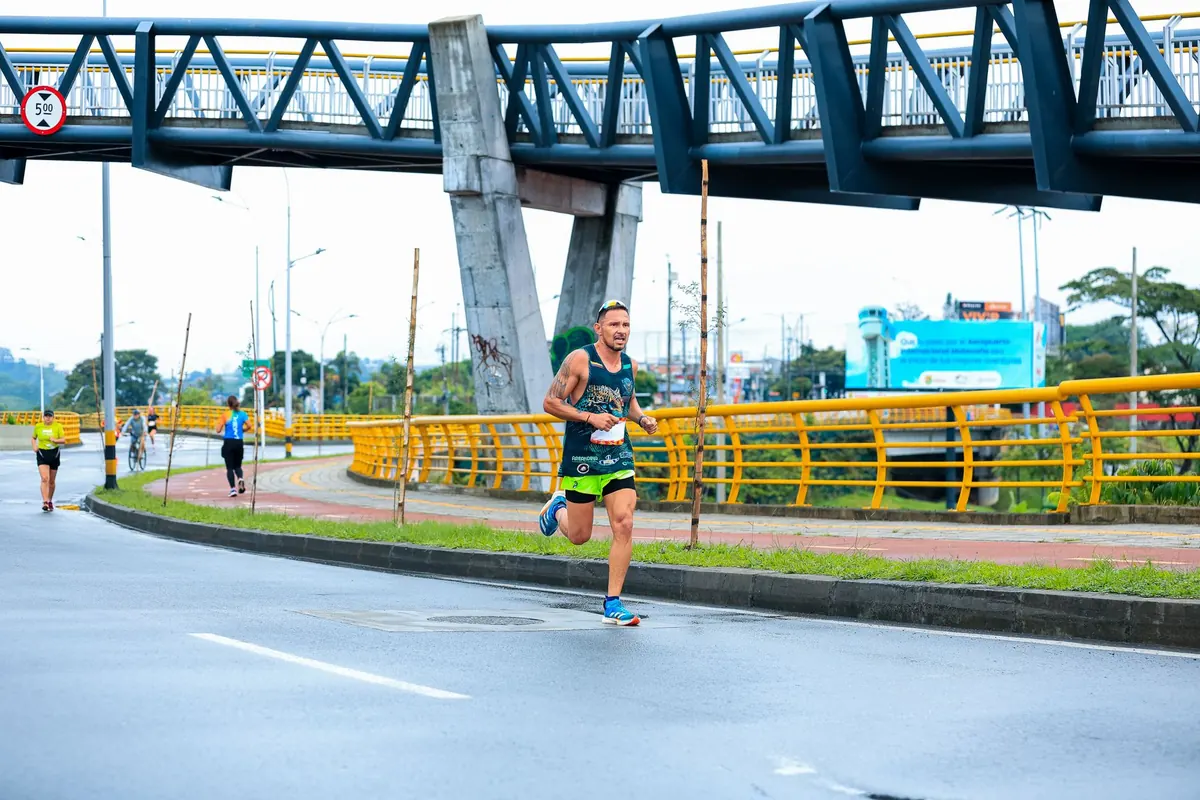
Two runners with identical fitness can line up at the same event and effectively race two different competitions. One gets an 8 a.m. start, cloud cover and 18°C. The other goes off at 2 p.m., on tarmac that has been baking since morning, with humidity high enough that sweat runs off the skin instead of evaporating. By the time the podium is settled, the difference is rarely about who trained harder in June. Summer racing rewards the people who read the conditions early and adjust before the race does it for them.
What Heat Actually Does to a Race
Hard efforts produce heat, and the body has to get rid of it. It does that by sending blood towards the skin, which is exactly the blood the working muscles wanted. The heart rate climbs even when the pace doesn't. Sweat rate rises, and when the air is already heavy with moisture, evaporation slows and the cooling system becomes less efficient. You feel all of this as a rising sense of effort at a pace that felt routine in April.
That is the part most athletes underestimate. Heat doesn't simply make a race harder in a vague, uncomfortable way. It changes the cost of every surge, every climb, every kilometre run at goal pace. A speed that asked for most of what you had in spring might ask for almost everything in July. Nothing about your legs changed. The price of using them did.
Humidity is the multiplier. A dry 30°C day is uncomfortable; a humid 27°C day can be worse, because sweat that drips to the ground has done nothing to cool you. That's why two races with similar numbers on the thermometer can feel completely different, and why a forecast alone is not enough information to plan a race.
Pacing: The First Twenty Minutes Decide More Than the Last
Most summer blow-ups are written early. Legs feel light in the cool of the morning, the first kilometre slips by quickly and the effort feels almost too easy. It is easy, at that moment. The bill arrives later, when the body is trying to cool itself and race at the same time.
The trap is that heat delays the feedback. You don't feel the damage as it happens; you feel it once it's already done. So set a ceiling before the gun goes off, based on effort rather than on the split you ran on a cool spring morning. If you use heart rate, expect it to sit higher than usual at the same speed and don't spend the race chasing a number that belonged to different weather. If you race by feel, check in every few minutes and ask a simple question: could I hold this for the whole distance on a hot day, not on a perfect one?
The positive split trap
There is a second pacing decision that matters just as much: what you do when someone goes past you. In heat, surges are expensive and rarely worth answering immediately. Let them go, hold your rhythm and see whether they are still there in the final third. Plenty of them won't be. The athletes who win in difficult conditions are often the ones who looked slightly conservative and slightly boring for the first half of the race.
Hydration and Sodium: Drinking Is Not the Whole Job
Under-drinking and over-drinking can both end a day badly, and summer racing is where both happen most often. The goal isn't to drink as much as possible. It's to arrive hydrated, replace a sensible amount as you go, and avoid a stomach that is sloshing while you ask it to run.
- Start hydrated, not bloated. Drinking a large volume in the twenty minutes before the start usually means carrying it around the course rather than using it.
- Test your plan in training. Bottles, sachets, gels and on-course drinks should all have been tried in warm weather before race day.
- Include sodium, particularly in longer events and for athletes who sweat heavily or find salt on their kit afterwards.
- Drink to a plan you have rehearsed, not to a number copied from someone else's race report.
- Use cold fluids where they're available; they help with cooling as well as hydration.
- Know the warning signs. Confusion, headache, nausea and swollen hands are reasons to stop and get help, not to push on.
If you have a medical condition, take medication, or expect extreme heat on race day, get individual advice from a qualified professional. General guidance is a starting point, not a prescription.
The Scheduling Problem: Start Times, Heats and Double Days
Schedules are built around permits, road closures, broadcast windows and venue availability, not around your physiology. A marathon may start at 6:30 while the 10km goes at 11. A championship may put heats in the morning and finals in the mid-afternoon, with a medal decided at the hottest hour of the day. Grassroots meets are worse still: you can warm up, race, then sit in the sun for three hours before your next event.
When the schedule is out of your hands
Arrive earlier than you think you need to and find shade before you need it. Keep a wet towel or a cooling collar in a bag with ice. Shorten the warm-up and do the activation in the shade rather than on the start-line tarmac. Eat around your own start time, not the group's. And if you have a long wait between rounds, treat it as part of the event: feet up, out of the sun, small sips, no unnecessary walking.
Tactics That Survive the Heat
Cooling is a skill, and it can be practised. Ice in a cap or a towel around the neck before the start buys comfort. On the course, take the shaded side of the road, use the water stations rather than skipping them because the queue looks long, and in cycling or rowing, sit in the group instead of taking pulls into a headwind on an exposed road.
Know where the shade is before you race. A course recon at the same time of day tells you which sections will be brutal and which will offer relief, and that shapes where you spend your effort. In road races, the winning move often comes after the exposed section, not during it, because that's when the field is most fragile.
How the Podium Changes Shape
In mild conditions, results tend to follow form. In heat, they follow form and judgement together. Winning times are often slower, gaps open in unexpected places, and the depth of finishers thins out. Athletes who were targeting a personal best sometimes end up in a survival contest instead, while someone who planned for a slower, more even race moves up quietly.
There is also a selection effect that has nothing to do with the day itself. Athletes who live and train in hot climates arrive with an advantage they earned over weeks, not minutes. Someone who has done their long sessions at midday in July handles a 2 p.m. final very differently from someone whose entire preparation happened in cool mornings. You can't fake that in a warm-up, but you can build it deliberately in the month before a summer target race.
The practical consequence is this: in heat, fewer athletes beat themselves, and more are beaten by the conditions. Podium places often go to whoever made the fewest avoidable mistakes, not to whoever was fittest on paper.
A Heat-Proof Race Plan
- Check the forecast for your actual start time, not for the day as a whole, and note the humidity as well as the temperature.
- Set an effort ceiling and a realistic pace range before you travel, and write it down so race-day adrenaline can't rewrite it.
- Practise your hydration and cooling in training, including at least one session in the heat of the day.
- Plan the hours around your start: shade, ice, food, and a shorter warm-up than usual.
- Race the first third conservatively and let the conditions, not the crowd, set the tempo.
- Have a stopping rule. If you feel confused, dizzy or seriously unwell, the sensible decision is to stop and get help.
None of this is dramatic. It's the ordinary work of taking the weather seriously, and in a summer race it's usually the difference between a result you can explain and one you can't.
Photo: Sidhick Kannur / Pexels